Clinicals in Clarkson's campus BSN and LPN to BSN
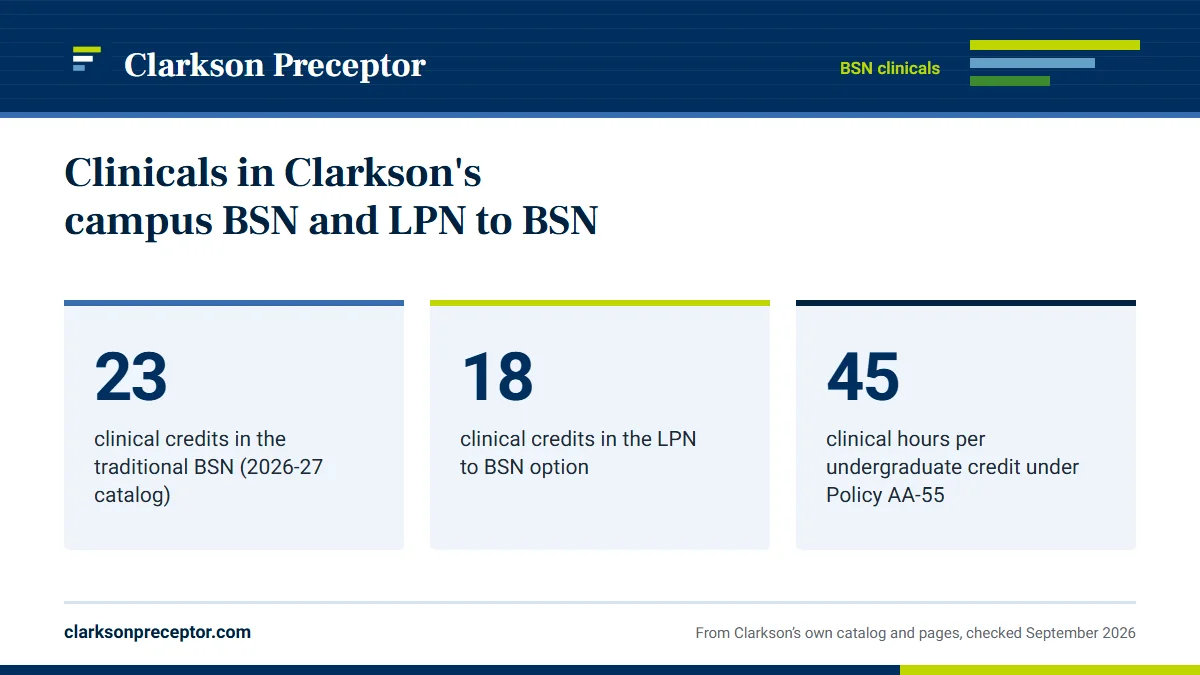
Clarkson College's traditional BSN carries 23 clinical credits and the LPN to BSN 18, taught in the Omaha campus skills and simulation labs and in hospitals, clinics and public health settings around the metro. The catalog speaks of clinicals being scheduled at agencies, and the program ends with the NRS 473 preceptorship. No published sentence says outright who arranges each site, so this guide shows what Clarkson does publish and where to confirm the rest.
Get your placement plan
Tell us your Clarkson program and where you live. A placement advisor replies with the preceptor and site options that fit your course.
The clinical courses, in order
Nursing courses begin in the second semester of year two, and that year's plan adds a "Third Semester," since Clarkson offers nursing coursework every term, summer included. The ATI program runs alongside the whole sequence and ends with the ATI Comprehensive Predictor. The table follows the 2026-27 catalog.
| Course | Credits | About | Focus | Taken by |
|---|---|---|---|---|
NRS 126 Foundational Skills and Assessment of the Adult: Clinical | 2 | 90 (Clarkson's example) | Adults, varied care settings | Traditional |
NRS 238 Medical-Surgical Nursing 1: Clinical Application | 3 | 135 | Adults with acute and chronic illness | Traditional |
NRS 321 Medical-Surgical Nursing 2: Clinical | 3 | 135 | Adults with acute and chronic illness | Both |
NRS 333 Behavioral Health Continuum of Care: Clinical | 2 | 90 | Behavioral health across the lifespan | Both |
NRS 335 Nursing Care of Women and Child-bearing Families: Clinical | 2 | 90 | Women and childbearing families | Both |
NRS 337 Family-Centered Nursing Care of Children: Clinical | 2 | 90 | Pediatrics | Both |
NRS 456 Community and Public Health in Practice: Clinical | 2 | 90 | Population-based care | Both |
NRS 459 Concepts of Complex Multisystem Clients I: Clinical | 3 | 135 | Multisystem disorders | Both |
NRS 473 Preceptorship: Clinical | 4 | 180 | Leadership and management, precepted | Both |
Policy AA-55 sets one undergraduate clinical credit at 45 hours and uses NRS 126 as its worked example: two credits, 90 hours. Applying the same ratio, the traditional BSN's 23 clinical credits come to about 1,035 hours and the LPN to BSN's 18 to about 810. Clarkson states the ratio, not those totals, so treat them as estimates.
What Clarkson publishes about clinical sites
The clearest wording is in the catalog's background check and drug screening policy. It refers to "the agency where the clinical is scheduled" and states that "No special accommodation for an alternative clinical placement will be made" when a background issue blocks a student at an agency. Read together, those lines describe clinicals that are scheduled for students at partner agencies, but neither says in so many words who does the scheduling.
Other pieces point the same way. Clarkson's 2021-22 undergraduate handbook describes clinicals across the Omaha and Council Bluffs metro and nearby communities and asks students to provide their own transportation. The BSN program page promises hands-on practice from the first year in "hospitals, clinics and other public health care settings." At least one health system's own published process runs through schools: CHI Health's undergraduate toolkit has a school coordinator submit clinical requests through myClinicalExchange.
For a definite answer, ask for the current Undergraduate Nursing Student Handbook, which Clarkson shares on request, or put the question to your enrollment and academic advisor or course faculty.
The final semester: NRS 473 Preceptorship
NRS 473 is the capstone clinical: four credits, taken in the last semester after every earlier clinical and theory course through NRS 459, alongside NRS 467, NRS 470, NRS 483 and NRS 484. You work beside a preceptor with a focus on leadership and management at the systems level. By the 45-hour ratio it is the longest clinical in the program, at about 180 hours.
Clarkson's LPN to BSN page describes it as "Preceptorship in last semester in area of students choosing," which suggests you get a say in the specialty. Some sponsorships connect to it too: the 2025-26 catalog lists "Preference for senior preceptorship placement" among the benefits of Children's Nebraska's Student to Nurse (S2RN) Sponsorship Program in Pediatrics.
Health systems set their own calendars for these spots; CHI Health's toolkit, for instance, publishes undergraduate preceptorship request dates for each term. Whatever process Clarkson runs, knowing your preferred area a term ahead puts you in the best position.
LPN to BSN: where you join the sequence
LPNs enter with a current, unencumbered LPN license from Nebraska or another state, effective in the state where clinicals will occur, and a 2.5 math and science GPA. The option runs "primarily on campus with some courses also available online," at five semesters full-time or eight part-time.
Advanced placement lets you skip NRS 117, NRS 125, NRS 126, NRS 237 and NRS 238. In their place you take NRS 150, NRS 227, NRS 236, NRS 339 and NRS 355, and passing NRS 339 and NRS 355 earns 16 validation credits. From there you join the second-level courses at NRS 320, so your clinicals are NRS 321 through NRS 473: 18 credits in seven courses. The catalog paragraph still prints "NS 227" from the old prefix, so match numbers carefully when you read older documents.
Admission, compliance and grades
The traditional BSN admits in fall, spring and summer with a 2.5 cumulative GPA and a 2.5 in math and science. The website says no prerequisites are needed to be admitted, yet the first nursing courses require BIO 210, BIO 211, BIO 213 and CHM 110, so plan those early. Clarkson lists the program at six semesters full-time and eleven part-time, while the catalog plan spans four years; the six appear to count the semesters with nursing courses.
Clinical access depends on staying compliant. Clarkson tracks immunizations, background checks, drug screens, BLS and the rest in Qualified First/Verified, and a student out of compliance cannot attend clinical. The 2021-22 undergraduate handbook also required a clinical skills checklist each semester and allowed an incomplete in a clinical course so missed hours could be made up the next semester, with progression paused until then. Grades need to be C- or better, and a course can be repeated once; the progression rules guide covers dismissal triggers and the health and safety guide the compliance items.
A curriculum rebuilt in 2025-26
If an older handbook or a classmate's notes use different course numbers, this is why. Clarkson rebuilt the BSN for 2025-26: NRS 117, NRS 150, NRS 236, NRS 237 and NRS 238 (Med-Surg 1), NRS 320 and NRS 321 (Med-Surg 2), NRS 455 and NRS 456, and NRS 484 replaced older numbers such as NRS 118, NRS 353 and NRS 474. Clinical credits in the traditional BSN fell from 25 in 2020-21 to 23 from 2022-23 on; the LPN option went from 21 to 19 to 18 in 2026-27, and its validation credit from 15 to 14 to 16.
The BSN holds ACEN accreditation and Nebraska State Board of Nursing approval, and Clarkson's state workbook marks its Undergraduate Nursing tab Meets in all 50 states. Our accreditation guide explains what those approvals cover.
Where our desk fits for BSN students
Campus clinicals appear to be scheduled through Clarkson, so our role for BSN students is focused. When the NRS 473 preceptorship lets you name an area, we help you think it through: which units and specialties near you build the leadership experience the course describes, and how that choice lines up with the career or graduate track you want next.
The larger partnership starts after licensure. Clarkson's MSN and BSN to DNP nurse practitioner tracks put the preceptor search for every clinical course on the student, and planning all five courses together is exactly what our placement desk does. Compare the tracks on our NP tracks page, and use the form below when you are ready to plan graduate clinicals.
Questions Clarkson students ask
Do Clarkson BSN students find their own clinical sites?
Clarkson does not state it in one sentence. The catalog describes clinicals as scheduled at agencies and rules out alternative placements for background-check problems, which points to Clarkson-scheduled sites. Confirm with the current Undergraduate Nursing Student Handbook, available on request, or with your advisor.
How many clinical hours are in Clarkson's BSN?
Clarkson's credit-hour policy counts 45 clinical hours per undergraduate credit and gives NRS 126 as a 90-hour example. At that ratio the traditional BSN's 23 clinical credits come to about 1,035 hours and the LPN to BSN's 18 credits to about 810. Those totals are our arithmetic, not a Clarkson figure.
Can I choose where my NRS 473 preceptorship happens?
Clarkson's LPN to BSN page describes the final preceptorship as being in an "area of students choosing," so expect some say in the specialty. How preferences are collected and matched is set by the program; ask course faculty or your advisor during the semester before your last one.
Do I need a car for Clarkson BSN clinicals?
Clarkson's 2021-22 undergraduate handbook placed clinicals across the Omaha and Council Bluffs metro and nearby communities and asked students to provide their own transportation. Plan for reliable travel to sites beyond the campus at 42nd and Dodge, and confirm current expectations in the handbook Clarkson shares on request.
Which BSN clinical courses does an LPN skip at Clarkson?
Advanced placement removes NRS 126 and NRS 238, along with NRS 117, NRS 125 and NRS 237. LPN to BSN students take seven clinical courses, NRS 321 through the NRS 473 preceptorship, for 18 clinical credits in the 2026-27 catalog.
Related pages
Last checked 2026-09-27
We check these pages against Clarkson College's own catalog, program pages and published nursing documents. Your course faculty and Graduate Nursing advisor have the final word.
Clarkson asks you to find your preceptor. We make the search the easy part.
Tell us your Clarkson track, your city and your next clinical course. We line up preceptors who fit the NRS course and Clarkson's rules, gather the details the site and preceptor agreement asks for, and flag early whether the site needs a new affiliation agreement.
- Preceptors matched to the course: all-ages primary care for FNP, acute care units for AGACNP, psychiatric providers for PMHNP
- License, experience and site details checked against Clarkson's rules before the agreement is filed
- Every clinical course planned in sequence, close to home in a state where Clarkson's graduate nursing meets requirements
Start your placement plan
Track, city and next clinical course is all we need to begin.