Finding your own preceptor at Clarkson College
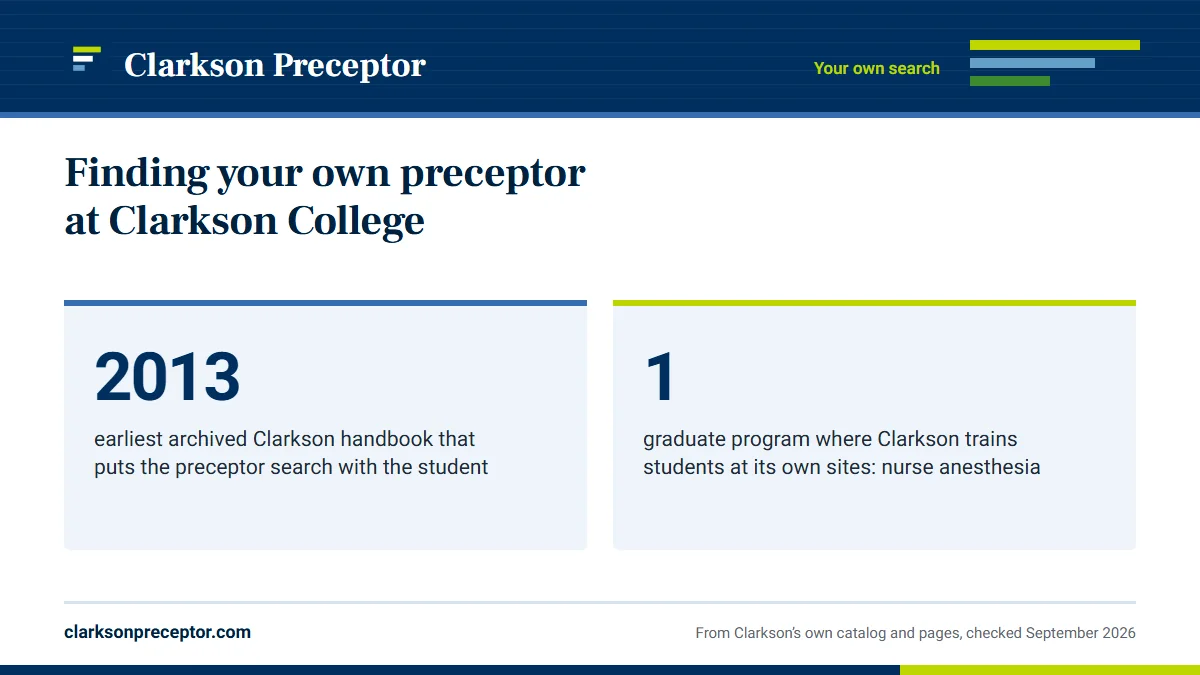
In Clarkson College's online graduate nursing programs, the preceptor search is yours: you identify the clinician and the site, and Clarkson approves both before you can register. The rule has held since at least 2013, and it gives you a real say in where, when and with whom you train.
Get your placement plan
Tell us your Clarkson program and where you live. A placement advisor replies with the preceptor and site options that fit your course.
What Clarkson's rule says
The current catalog states the rule by its effect: each nurse practitioner clinical course requires preceptor and clinical site approval before registration, and the education and leadership practicums say the same of the practicum site. Who does the finding is spelled out in the graduate handbook. Clarkson's 2021-22 edition put it this way on page 24: "It is the responsibility of each student, not the College or Graduate Nursing program, to identify appropriate preceptors and/or clinical/practicum sites."
The rule is long-standing. Clarkson's 2013-14 MSN handbook made the student responsible for identifying a preceptor for each clinical experience, and a 2014 program FAQ told students they could choose their own preceptors and sites within the college's guidelines. The clinical sheets revised in November 2023 still named the student as the one who starts the agreement.
Who it covers, and the one exception
The rule reaches every online graduate path: the MSN in family, adult-gerontology acute care and psychiatric-mental health nurse practitioner practice, the MSN in Nursing Education and in Nursing Healthcare Administration, the post-graduate certificates, and the BSN to DNP nurse practitioner tracks. DNP students also recruit their own project mentor, whom Clarkson's 2023-24 DNP Hours Guide calls the External Subject Area Expert/Mentor. Post-graduate DNP students, already certified as nurse practitioners, look for that mentor and for anyone they may be asked to shadow or interview.
Nurse anesthesia is the exception. That program trains residents at its own clinical sites, and its current policy says it will not open a new site because an individual resident asks for one. Campus BSN clinicals appear to be scheduled by Clarkson as well, though no current page says so outright.
Why an online program works this way
Clarkson's handbook gave the reason plainly: its graduate students live throughout the United States, so each one locates a preceptor and site suited to their own needs. The MSN page makes the same point from the student's side, listing clinical and practicum sites in or near your hometown among the program's features.
The division of labor is clear. You bring a clinician who fits the course. Clarkson checks the course and term, secures the contract with the site, collects the preceptor's credentials, approves the placement and tracks your hours. Students who start early can choose a practice they might like to join after graduation, a schedule that works around their RN shifts, and a preceptor known as a good teacher.
Reading the "1,000+ clinical sites" line
Clarkson's nursing page advertises "Access to 1,000+ clinical sites across 45 states." It is marketing copy, and it answers a different question from the one a graduate student has. The line does not say who finds a graduate site, it is not broken down by program, and nothing beside it changes the catalog note that approval comes before registration.
Read it as Clarkson describing its reach, not as an offer to place you. Where it can help is the paperwork: ask your advisor whether a clinic you are considering already has an affiliation agreement with Clarkson, because an existing agreement spares the Compliance office from starting a new contract. Where your clinical can be approved at all is settled by Clarkson's state workbook, not by this figure.
When to start, and what to line up first
Start as soon as you are admitted. Clarkson's 2021-22 handbook expected graduate students to start interviewing and screening preceptors and sites "upon entering the program," well before the first clinical course.
For nurse practitioner students, that first course is NRS 830 Advanced Physical Assessment: 100 hours for MSN and certificate students and 125 for BSN to DNP students, with hours starting only after the Graduate Weekend check-off in Omaha. Clarkson's 2013-14 handbook named the first target as a general practice primary care provider secured before registering for it. From there, work backward from the paperwork deadlines in the deadline guide and from the time a new affiliation agreement can take.
Education and leadership students start the same way, with an experienced educator or administrator who holds at least an MSN and can host the whole practicum alone, since those courses allow one preceptor.
Where Clarkson students look
- Your own employer, in another department. Clarkson requires graduate students to keep working as RNs and allows clinicals at the workplace outside the student's own unit; the workplace guide sets out the conditions.
- Health systems' own request routes. Several systems in Nebraska, Iowa and South Dakota take NP student applications through their own portals and windows, and they ask you to apply rather than approach their clinicians. The health system guide covers each one.
- Independent and rural practices near home. Outpatient primary care and rural health clinics are named FNP settings; psychiatric practices, community mental health centers and crisis units are named PMHNP settings.
- Clinicians you know professionally. Former colleagues and providers you have worked beside as an RN, provided they meet the rules and are not relatives.
- A placement service. Our desk runs the search for you; see how to choose one.
The same handbook adds a caution: students "should NOT contact the preceptor directly" where a location has its own channel. Read with the rest of that section, which makes the search your job, it means going through each organization's official route, such as a health system's placement office, rather than around it.
What to confirm before you ask for a yes
A preceptor who agrees and then fails Clarkson's review costs you weeks. Before you ask, compare the candidate with Clarkson's preceptor rules: a license in the state where you will train, at least two years in practice, a practice that matches the course, and no family tie. If the candidate is a physician assistant, check your state and your track as well, because Clarkson limits PAs by both.
Then settle the practical side. Ask how many hours a week they can host, since a 160-hour course comes to about 11 a week across a 15-week term by our count. Ask which other providers in the practice you would see patients with, because each one needs an agreement, and get the organization's exact legal name for the form.
How we take the search off your hands
Clarkson students hand the search to us because it is the step that decides everything after it. Our placement desk looks for clinicians near you whose practice fits your next NRS course, screens each one against Clarkson's rules for your track, and confirms they can carry the hours in your term.
You get a preceptor who is ready to sign, the details the DocuSign agreement needs already gathered, and an early warning if Clarkson has no contract with the site yet. While one course runs, we are already lining up the next. Clarkson's advisors and faculty still make every approval; we make sure the preceptor in front of them already fits. Tell us your track, city and next course in the form on this page.
Questions Clarkson students ask
Does Clarkson College find preceptors for its online MSN students?
No Clarkson source says it does. The archived graduate handbooks from 2013-14 through 2021-22 and the clinical sheets revised in November 2023 all place the search with the student, and no current Clarkson page offers to place graduate students. Nurse anesthesia is the one graduate program that trains at sites Clarkson arranges itself.
Will my advisor suggest preceptors for me?
Clarkson describes its Graduate Nursing advisors as overseeing the agreement form, Typhon, My Clinical Exchange and health and safety, and its 2025 resources page routed Avera and Sanford requests through its MSN advising team. No source describes advisors supplying NP preceptor names. For DNP students, the 2023-24 DNP Hours Guide says the program director can help identify a project mentor.
Is it acceptable to use a placement service for a Clarkson clinical?
Clarkson's published sources say nothing either way about placement services. What Clarkson controls is the approval: every preceptor and site passes the same review by your advisor, the Compliance office, Graduate Nursing and course faculty, however you found them. Our checks are built around exactly that review, so the preceptor we bring you is ready for it.
Do I need a different preceptor for each clinical course?
Not always, but you need a new agreement for each course, and the course content often forces a change. FNP students need a pediatric provider for most of NRS 840 and a women's health provider for most of NRS 842, while AGACNP settings shift from short-stay units toward ICU and emergency care as the courses advance.
What if I move during the program?
Speak with your program director first. Clarkson's state authorization page says relocating to a state where the program lacks authorization may end your eligibility for some financial aid or leave you unable to complete the program, and both your RN license and your preceptor's license need to match the state where you train.
Related pages
Last checked 2026-09-27
We check these pages against Clarkson College's own catalog, program pages and published nursing documents. Your course faculty and Graduate Nursing advisor have the final word.
- Clarkson College 2026-27 catalog: NRS 830 Advanced Physical Assessment
- Clarkson College Nursing (programs and clinical sites)
- Clarkson College Master of Science in Nursing
- Clarkson College Graduate Nursing Student Handbook 2021-22 (archived copy)
- Clarkson College DNP Hours Guide 2023-2024 (archived copy)
Clarkson asks you to find your preceptor. We make the search the easy part.
Tell us your Clarkson track, your city and your next clinical course. We line up preceptors who fit the NRS course and Clarkson's rules, gather the details the site and preceptor agreement asks for, and flag early whether the site needs a new affiliation agreement.
- Preceptors matched to the course: all-ages primary care for FNP, acute care units for AGACNP, psychiatric providers for PMHNP
- License, experience and site details checked against Clarkson's rules before the agreement is filed
- Every clinical course planned in sequence, close to home in a state where Clarkson's graduate nursing meets requirements
Start your placement plan
Track, city and next clinical course is all we need to begin.