Nurse anesthesia at Clarkson: the program that assigns your clinical sites
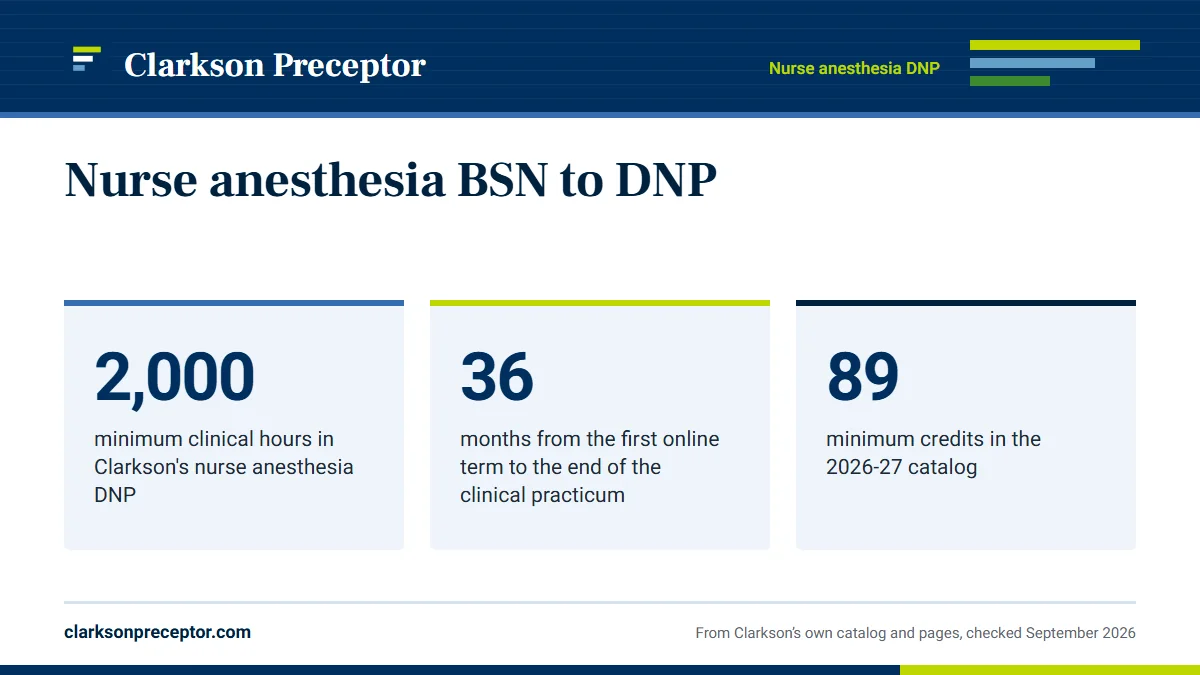
Clarkson College's BSN to DNP in Nurse Anesthesia is the one graduate nursing program where the college lines up the clinical sites for you. Residents rotate through facilities the program has vetted, credentialed and visits every year, and log at least 2,000 clinical hours in a 16-month practicum. Our preceptor search serves Clarkson's other graduate tracks, which the last section of this page lays out.
Get your placement plan
Tell us your Clarkson program and where you live. A placement advisor replies with the preceptor and site options that fit your course.
Three phases over 36 months
The program is full-time only and front-loaded. Clarkson's program page describes a 20-month didactic phase, the first 8 months online and the next 12 on the Omaha campus, followed by a 16-month clinical practicum: 36 months, or nine semesters, in all. Clarkson's MSN, certificate and other DNP options all publish part-time schedules; this one moves as a single full-time cohort.
The 2026-27 catalog lists at least 89 credits. Twenty-eight sit in the DNP core, where ANA 960 through ANA 962 carry the scholarly project, and 61 in the anesthesia specialty, with ANA 963 and ANA 964 adding an optional one to three. The campus year leans on simulation for general and regional anesthesia, central lines and airway skills. Lab courses such as ANA 872L count 15 contact hours per credit under Policy AA-55.
| Phase | Length | Setting |
|---|---|---|
| Didactic, first part | 8 months | Online, off campus |
| Didactic, second part | 12 months | Omaha campus, with simulation |
| Clinical practicum | 16 months | Program-assigned sites, urban and rural |
Why the program chooses the sites
Anesthesia training depends on case mix, anesthesia staffing and tight supervision ratios, so Clarkson keeps site selection inside the program. Policy C2, revised April 2026, puts it in one line: "The program does not set up new clinical sites at the request of individual residents." Residents train where the program's clinical sites can give them the cases the curriculum calls for.
The policies spell out what stands behind each site. Clarkson uses only Joint Commission accredited facilities. Each site has a clinical coordinator, appointed jointly by the program and the site, who is a CRNA with a master's degree or higher or an anesthesiologist. Under Policy V1 the program visits every clinical site each year.
Rotations must span urban and rural facilities, inpatient and outpatient care. The program page lists specialty exposure in cardiothoracic, neuro, trauma, transplant, obstetric, pain with fluoroscopy and dental anesthesia, and says pediatric internships may take place at Children's Hospital & Medical Center. For a resident, the search, the contracts and the site vetting are already done; the task is to stay credentialed and ready for wherever the rotation schedule leads.
Hours, call and supervision in the clinical phase
The clinical phase runs through ANA 951 to ANA 954, Clinical Anesthesia Practicum I to IV, at three credits each. Together they must produce at least 2,000 clinical hours; the catalog gives no per-course split. Policy AA-55 says clinical time will "never exceed 64 hours per week," averaged over four weeks.
Policy T1 sets the rhythm. Once in Clinical Phase II, residents "no longer follow the college calendar," and evening, night, weekend and holiday call are part of the schedule. The Clinical Correlation Conference Seminars, ANA 901 to ANA 904, keep a classroom thread running through the practicum, and passing ANA 954 requires reaching the program's benchmark on the National Self-Evaluation Exam (SEE).
Supervision starts close and widens with experience. Policy S3 allows no more than two residents per CRNA, or per anesthesiologist when no CRNA is involved. Residents work one to one for about the first six months; from roughly month 6 to month 18 the ratio can be one to one or two to one. The doctoral side adds at least 125 DNP professional practice hours, which our DNP hours guide explains alongside the other DNP options.
Admission: critical care experience and a Dec. 1 deadline
Nurse anesthesia is the exception to Clarkson's rolling graduate admission. Applications are due Dec. 1, 2026 for a spring start only, and top applicants interview on campus Feb. 16-18, 2027. Those interviews fall after Spring 2027 opens on Jan. 7, so the class this cycle fills most likely begins in Spring 2028; the page itself says only "the following spring semester," so confirm the start term with Clarkson admissions.
What the admission page asks for
- A 3.0 cumulative GPA and a 3.0 across the prerequisites: college math, pharmacology, microbiology, anatomy, physiology, pathophysiology, chemistry and physical assessment.
- A BSN completed by the start of the term.
- At least one year of recent U.S. critical care RN experience (ICU, CCU, MICU, NICU, PICU, SICU or equivalent).
- An RN license, and any APRN license you hold, effective where your clinicals will happen. Policy C2 asks for a license valid under the enhanced Nurse Licensure Compact, or licenses in both Nebraska and Iowa.
- After acceptance,
GRD 798and a graduate-level statistics course equal toGRD 847, both before you enroll. - BLS, ACLS and PALS kept current for the whole program.
The program page states class size two ways, a "maximum of 24 students per class" in one spot and 22-28 students in another. Admissions can tell you which figure applies to your cohort.
Keeping your place in a lock-step cohort
Because residents move as one group, the progression rules are stricter than in the online tracks. Policy P7 expects a B average, 83 percent, in every ANA and DNP course by the end of each semester. Under catalog Policy AA-2, a resident who fails a course "will not progress with their cohort" and must reapply for the following year.
Clinical standing carries the same weight. Policies S1 and P7 list a clinical site ending a resident's rotation among the events that lead to dismissal, and Policy C2 removes any resident with an expired credential from clinical. Policy P4 covers extensions of the clinical phase and makes no promise that a site will be open for the extra time.
Our progression rules guide sets these beside the grade and time-limit rules for Clarkson's other nursing programs.
Accreditation, state rules and recent changes
The Council on Accreditation of Nurse Anesthesia Educational Programs (COA) accredits the program through June 2036, and the Higher Learning Commission has accredited Clarkson College since 1984. Clarkson's AY 2026-27 state workbook gives nurse anesthesia its own CRNA tab: the 12 states marked Does Not Meet for graduate nursing plus North Dakota, which leaves 37 Meets and 13 Does Not Meet. North Dakota switched to Does Not Meet on that tab in 2025. Our state authorization guide has every row.
The program's shape has also changed in recent catalogs. An MSN with a nurse anesthesia specialization appeared through 2022-23 and then dropped out, leaving the BSN to DNP as the only route. The clinical practicum went from 15 credits in five courses (AN 951 to AN 955) to 12 credits in four, and the current ANA 954 description still refers to an ANA 955 that no longer exists.
Where our preceptor search fits
Clarkson arranges clinical sites for nurse anesthesia residents, so our placement desk serves the rest of its graduate nursing students: the MSN Family, Adult-Gerontology Acute Care and Psychiatric-Mental Health NP tracks, the matching post-graduate certificates and BSN to DNP options, the project mentor in the DNP post-graduate option, and the Nursing Education and Healthcare Administration practicums. In every one of those, Clarkson's graduate handbook hands the preceptor and site search to the student.
If you are an ICU nurse deciding between nurse anesthesia and the acute care NP track, that contrast matters. The NP tracks admit on a rolling basis, run online with one Graduate Weekend, and need an approved preceptor for each of five clinical courses. That search is exactly what our desk is built for: we find acute-care-certified NPs and physicians on the unit types each course names, check them against Clarkson's rules, and have the DocuSign details ready well before the deadline. Compare the options on our NP tracks page, then use the form to start a plan.
Questions Clarkson students ask
Do Clarkson nurse anesthesia residents find their own clinical sites?
No. Nurse anesthesia is the one Clarkson graduate program that places residents at its own clinical sites. The program selects and credentials the facilities, appoints a clinical coordinator at each, and visits them every year. Its policy also rules out adding a new site at a resident's request, so expect to rotate wherever the schedule sends you, rural facilities included.
How many hours a week is the Clarkson CRNA clinical phase?
Clarkson's credit hour policy caps clinical time at 64 hours a week, averaged over four weeks. In Clinical Phase II residents leave the college calendar behind and take evening, night, weekend and holiday call. Plan the 16-month practicum as your main commitment, and keep the 2,000-hour minimum in view from the first rotation.
When is the application deadline for Clarkson's nurse anesthesia DNP?
Dec. 1, 2026, for a spring-start cohort, with on-campus interviews for top applicants on Feb. 16-18, 2027. Every other Clarkson graduate nursing program uses rolling admission. Because the interviews fall after Spring 2027 has begun, ask admissions which spring term the incoming class actually starts.
What license does the Clarkson CRNA program require?
An unencumbered RN license effective where your clinicals happen, plus any APRN license you already hold. Clarkson's credentialing policy asks for an RN license valid under the enhanced Nurse Licensure Compact or licenses in both Nebraska and Iowa, and residents keep BLS, ACLS and PALS current throughout.
I am already a master's-prepared nurse anesthetist. Which Clarkson program fits?
Look at the DNP post-graduate option. Its program page names nurse anesthetists in the opening line, though other lines describe it for certified nurse practitioners, so confirm eligibility with the program. That route has no program-assigned sites: you choose a project mentor yourself, and our desk can find one who fits your project.
Related pages
Last checked 2026-09-27
We check these pages against Clarkson College's own catalog, program pages and published nursing documents. Your course faculty and Graduate Nursing advisor have the final word.
- Clarkson College: Doctor of Nursing Practice in Nurse Anesthesia
- Clarkson College 2026-27 Catalog: BSN to DNP, Nurse Anesthesia
- Clarkson College CRNA Policy C2: Credentialing at Clinical Sites (April 2026)
- Clarkson College CRNA Policy T1: Time Commitment (April 2026)
- Clarkson College: Nurse Anesthesia Admission Requirements
Clarkson asks you to find your preceptor. We make the search the easy part.
Tell us your Clarkson track, your city and your next clinical course. We line up preceptors who fit the NRS course and Clarkson's rules, gather the details the site and preceptor agreement asks for, and flag early whether the site needs a new affiliation agreement.
- Preceptors matched to the course: all-ages primary care for FNP, acute care units for AGACNP, psychiatric providers for PMHNP
- License, experience and site details checked against Clarkson's rules before the agreement is filed
- Every clinical course planned in sequence, close to home in a state where Clarkson's graduate nursing meets requirements
Start your placement plan
Track, city and next clinical course is all we need to begin.