Nebraska NP law and what it means for your preceptor
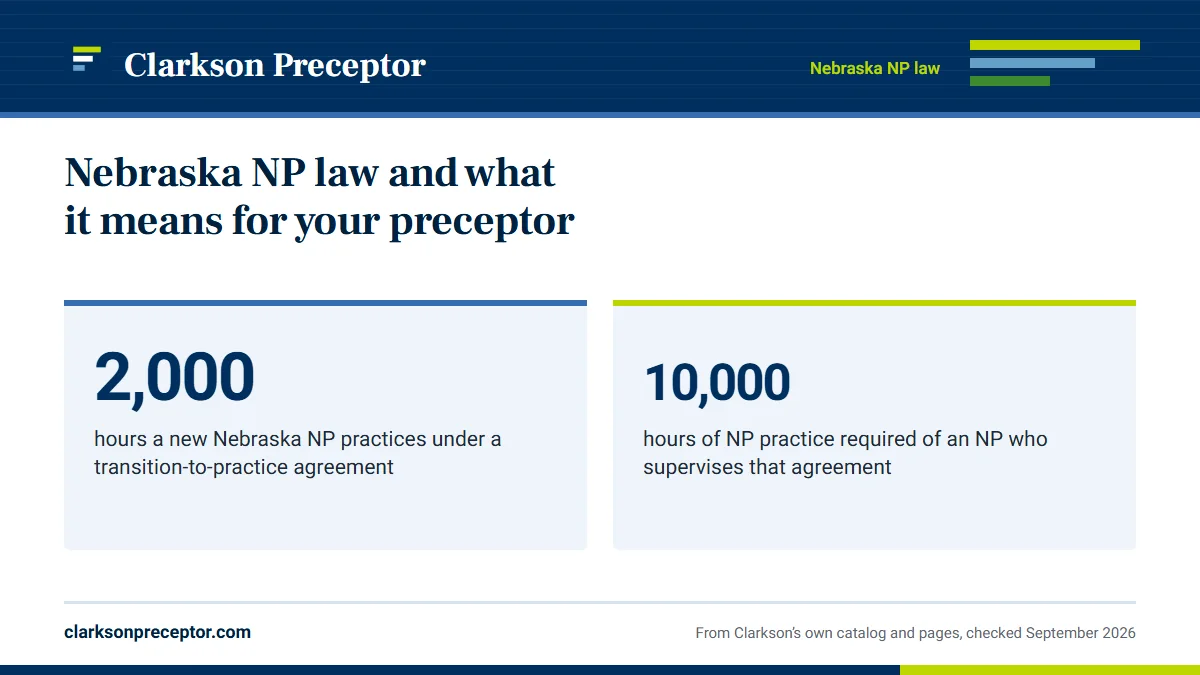
Nebraska licenses nurse practitioners through its Department of Health and Human Services, and since July 1, 2026 the Board of Nursing, not a separate APRN board, oversees them. New NPs spend their first 2,000 hours under a transition-to-practice agreement, prescriptive authority comes with the license, and the state leaves preceptor standards for graduate programs to the school. For a Clarkson College student training in Nebraska, Clarkson's own preceptor rules therefore decide who can teach you.
Get your placement plan
Tell us your Clarkson program and where you live. A placement advisor replies with the preceptor and site options that fit your course.
Who oversees Nebraska NPs after July 1, 2026
LB346, signed May 30, 2025, ended Nebraska's Board of Advanced Practice Registered Nurses on July 1, 2026. From that date, the word "board" in the APRN Practice Act and the Nurse Practitioner Practice Act means the Board of Nursing.
The Board of Nursing grew to fit its new job: ten RN members, four of whom are advanced practice registered nurses, plus two LPN members and three public members. DHHS board rosters from July and September 2026 already seat nurse practitioners, clinical nurse specialists and nurse midwives on the Board of Nursing, their terms dated from July 1, 2026.
Licenses themselves still come from the DHHS Division of Public Health's Licensure Unit, which issues APRN-NP, CNM, CNS and CRNA licenses. For a student, the change alters where APRN questions go after graduation; nothing in it touches the clinical hours Clarkson sets for your degree.
The 2,000-hour transition-to-practice agreement
Nebraska statute 38-2317 lists what an NP license requires: a Nebraska RN license or compact privilege, an accredited graduate NP program, a national certification exam, and evidence of 2,000 hours of NP practice under a transition-to-practice agreement, a collaborative or integrated practice agreement, independent practice, or a mix. Section 38-2314.01 defines the transition agreement as a collaborative agreement covering those first 2,000 hours between the NP and a supervising provider.
Section 38-2322 sets the terms. The supervising provider is a physician, osteopathic physician or nurse practitioner licensed and practicing in Nebraska in the same or a related specialty, and an NP in that role needs 10,000 hours of practice.
DHHS's application instructions add a practical step: an applicant with fewer than 2,000 hours since graduation and certification attests to having a formal written transition-to-practice agreement. AANP classifies Nebraska as a full practice state once those hours are complete.
Prescribing, controlled substances and insurance
Section 38-2315 puts prescribing therapeutic measures and medications inside NP practice, alongside diagnosis and treatment.
DHHS grants prescriptive authority at the moment of licensure, with no separate application or permit. For controlled substances, an NP needs a federal DEA registration, and Nebraska issues no state controlled-substance registration of its own. LB731 requires NPs to complete three hours of opioid-prescribing continuing education, half an hour of it on the prescription drug monitoring program, at each renewal through the 2028 cycle.
Section 38-2320 requires NPs to carry professional liability insurance. On the student side, Clarkson's own liability coverage sits under its Policy SW-12, and Clarkson's resources page told students to request certificates of liability insurance from the Compliance office when a site asks.
What the state says about preceptors and programs
Nebraska's licensing office states plainly that programs for nurses who already hold a license, online or on site, fall outside the Board of Nursing's regulation. For those programs, including MSN, DNP and certificate clinicals, preceptor qualifications are whatever the nursing program sets. The office also says programs work directly with clinical facilities to arrange preceptors, which at Clarkson takes the form of the Compliance office's affiliation agreements with the sites students identify.
One state rule does bind the school: whoever teaches Clarkson's APRN students while those students are in Nebraska must hold a Nebraska APRN license. That obligation sits with Clarkson, not with you or your preceptor.
The upshot is that Clarkson's requirements are the operative ones inside Nebraska: a preceptor licensed in the clinical state, at least two years of experience, practice that fits the course, no family members and the track rules for FNP, AGACNP and PMHNP. Every item is spelled out on the preceptor requirements page.
Who that leaves able to precept you
- Newly licensed NPs still inside their 2,000 transition hours practice legally, but Clarkson's two-year minimum (no exceptions in its 2023 sheets) sits well above that period; 2,000 hours is about one year of full-time work (our arithmetic)
- Experienced Nebraska NPs, physicians and DOs whose practice matches your course, with acute care certification required of NP preceptors for AGACNP courses
- Physician assistants for FNP and AGACNP courses and for
NRS 830: Nebraska is not one of the four states (Florida, Oklahoma, Arizona, Maryland) where Clarkson's sheets bar PA preceptors - Psychiatrists and PMHNPs for PMHNP courses after
NRS 830, plus a licensed master's-prepared therapist for 50 hours ofNRS 856
The 10,000-hour bar applies only to an NP supervising a new NP's transition agreement. It is a state rule for that relationship, separate from anything Clarkson asks of a student preceptor.
Incentives, compacts and the Nebraska state guide
Nebraska offers no state tax credit for NP preceptors that we could find. LB305, the 2025 Preceptorship Tax Credit Act, covered only licensed physicians precepting students of an accredited medical school in the state as introduced, and its final status was not verified.
Your RN license travels well here: Nebraska and all six neighbors belong to the Nurse Licensure Compact. The APRN license does not. Nebraska has not enacted the APRN Compact; among its neighbors only South Dakota and Wyoming have, and the compact is not yet in effect. The Nebraska state guide covers the rest of the state picture, and the Omaha preceptor guide covers the metro's systems.
For preceptors outside Nebraska, the incentive picture differs by state. Iowa, for example, credits continuing education hours to nurses who precept, which the Omaha guide mentions for Council Bluffs.
Where we fit for Nebraska students
Clarkson students choose us because we screen every Nebraska preceptor against the rules that actually govern here, which are Clarkson's. Your placement advisor confirms the preceptor's Nebraska license and years in practice, checks acute care certification for AGACNP courses, and assembles the details the agreement asks for. If you hope to practice where you train, we keep that goal in view when choosing among qualified preceptors, though any transition-to-practice agreement is between you and the employer. When a preceptor leaves partway through a term, your advisor starts on a replacement that same week, screened the same way. Start with the form below or the how it works page.
Questions Clarkson students ask
Can a newly licensed Nebraska NP precept a Clarkson student?
Not under Clarkson's published rules. Clarkson's November 2023 sheets required at least two years of experience with no exceptions, while a new Nebraska NP's transition-to-practice period covers the first 2,000 hours, roughly one year of full-time work.
Does the July 2026 Board of Nursing change affect my clinical hours?
No change to your hours has been published. The Board of Nursing does not regulate post-licensure programs, so Clarkson's 2026-27 catalog still sets your clinical hours: 750 in each MSN NP track and 975 in the BSN to DNP. The Board change matters after graduation, when you apply for your NP license.
Do I need a transition-to-practice agreement before I apply for a Nebraska NP license?
If you have fewer than 2,000 hours of NP practice, yes. DHHS's application instructions ask applicants in that position to attest that they have a formal written agreement with a supervising provider: a Nebraska physician, DO or NP in a related specialty, with 10,000 hours of practice if the supervisor is an NP.
Do Nebraska NPs need a state controlled-substance registration?
No. DHHS says Nebraska issues no separate state controlled-substance registration; an NP prescribing controlled substances needs a federal DEA registration. Prescriptive authority itself arrives with the NP license. NPs also complete three hours of opioid-prescribing continuing education at each renewal through 2028.
Is Nebraska in the APRN Compact?
No. Nebraska has not enacted it. Among its neighbors, South Dakota and Wyoming have, but the compact operates only once seven states enact it, so every state still issues its own APRN license. Your RN license, by contrast, is covered by the Nurse Licensure Compact, which Nebraska joined in 2018.
Related pages
Last checked 2026-09-27
We check these pages against Clarkson College's own catalog, program pages and published nursing documents. Your course faculty and Graduate Nursing advisor have the final word.
Clarkson asks you to find your preceptor. We make the search the easy part.
Tell us your Clarkson track, your city and your next clinical course. We line up preceptors who fit the NRS course and Clarkson's rules, gather the details the site and preceptor agreement asks for, and flag early whether the site needs a new affiliation agreement.
- Preceptors matched to the course: all-ages primary care for FNP, acute care units for AGACNP, psychiatric providers for PMHNP
- License, experience and site details checked against Clarkson's rules before the agreement is filed
- Every clinical course planned in sequence, close to home in a state where Clarkson's graduate nursing meets requirements
Start your placement plan
Track, city and next clinical course is all we need to begin.