Clarkson College preceptor requirements, track by track
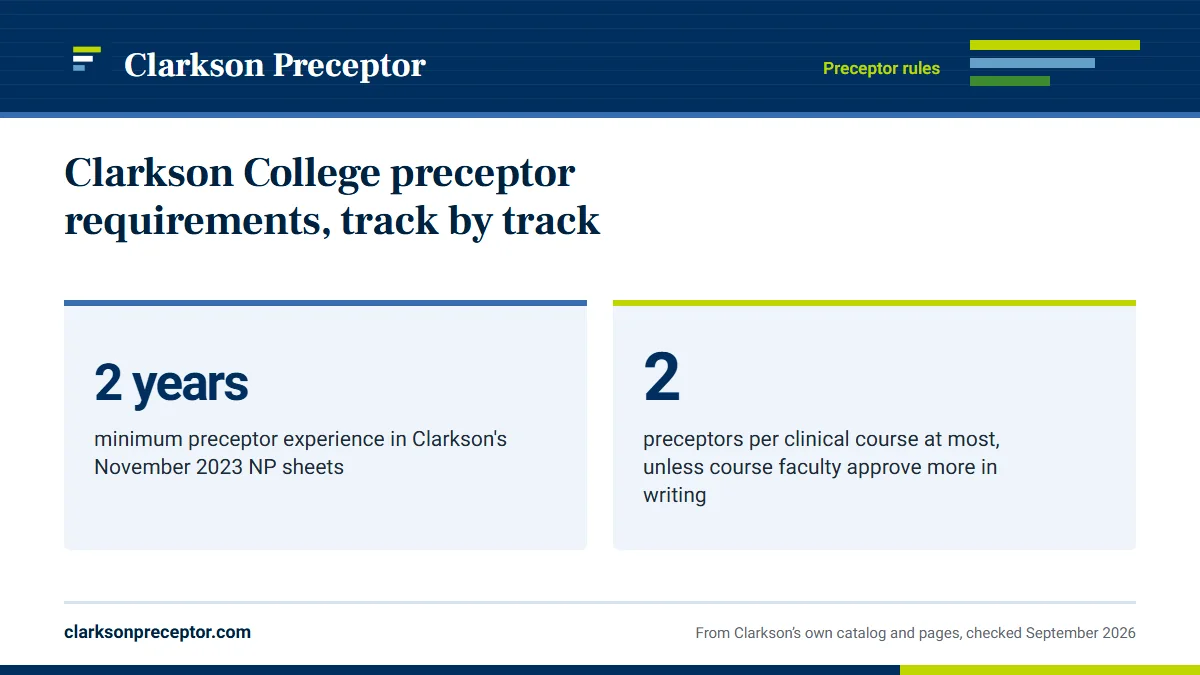
Every Clarkson College nurse practitioner preceptor must hold a license in the state where you train, have at least two years of experience and practice in an area that fits the course. Each track then adds its own rules on credentials and settings, and the education and administration practicums follow a separate set.
Get your placement plan
Tell us your Clarkson program and where you live. A placement advisor replies with the preceptor and site options that fit your course.
Where the rules come from, and how current they are
Your school sets these rules, not your state board. Nebraska's licensing agency says its Board of Nursing does not regulate post-licensure programs and that preceptor qualifications for them are established by the nursing program. Clarkson's current catalog enforces the result: no registration in a clinical course until the preceptor and site are approved.
The rules themselves were last published in Clarkson's Clinical Rotation Information sheets for FNP, AGACNP and PMHNP, revised in November 2023, and for the practicums in the 2021-22 Graduate Nursing Student Handbook. Clarkson has since removed both from its public site, along with the Nurse Practitioner Preceptor Handbook it linked for 2024-25. Treat the details below as dated, and confirm the current version with course faculty or your Graduate Nursing advisor.
The rules at a glance
The whole set on one screen, dated to the November 2023 clinical sheets and, for the practicums, the 2021-22 handbook. The sections below explain each line and the exceptions.
| Track and course | Who may precept | Key limit |
|---|---|---|
| All NP tracks | Licensed in your clinical state, 2+ years, practice related to the course | No relatives; 2 preceptors per course; no PAs in FL, OK, AZ or MD |
| FNP, every course | MD, DO, PA or NP in all-ages outpatient primary care or a rural health clinic | No hospitalist hours; no aesthetic dermatology |
FNP, NRS 840 | Pediatric primary care provider for 110 hours or more | Specialty hours capped at 50 |
FNP, NRS 842 | Women's health provider for 120 hours or more | Specialty hours capped at 40 |
AGACNP, NRS 830 | MD, DO, NP or PA in family practice or internal medicine | Baseline rules only |
AGACNP, NRS 861 to NRS 864 | MD, DO, PA, or an NP with acute care certification | FNPs excluded |
PMHNP, NRS 830 | MD, DO, NP or PA in family practice | No telehealth |
PMHNP, NRS 856 to NRS 859 | Psychiatrist or PMHNP; a therapist for 50 hours of NRS 856 | No PAs; telehealth up to 300 hours |
NRS 894, NRS 898 | Nurse educator or nursing administrator, 2+ years, MSN or higher | One preceptor per course |
The baseline for every NP preceptor
The November 2023 sheets apply these to all three nurse practitioner tracks:
- Licensed where you train. In the sheets' words, preceptors must be "currently licensed in the state where you intend to do your clinical."
- Two years of experience, a floor the sheets mark "(no exceptions)".
- A practice that fits the course. The preceptor works in an area related to the course content.
- No relatives. Family members cannot precept, and hours spent with one do not count; who cannot precept you covers the full list of exclusions.
- Two preceptors per course at most, unless course faculty approve more in writing.
- Outside your own department. If you work at the site, your clinical hours happen away from your own unit.
- Physician assistants only where allowed. Where a track accepts PAs, the sheets still rule them out in Florida, Oklahoma, Arizona and Maryland.
Each preceptor also signs an agreement, and so does every provider you see patients with, partners in a practice among them, as the agreement guide explains.
Family nurse practitioner preceptors
Physicians, physician assistants and nurse practitioners can all precept FNP students, provided they work in an outpatient primary care clinic or a rural health clinic whose patients span every age. Hospitalist hours do not count, and aesthetic dermatology is not an accepted specialty.
Two courses carry a population minimum. In NRS 840, at least 110 hours are with a pediatric primary care provider (an MD, DO, APRN or PA), and no more than 50 with a specialist who sees children. NRS 842 needs 120 or more hours in women's health. The sheet accepted OB/GYN physicians (MD or DO), certified nurse midwives with gynecology making up 50% or more of their caseload, and FNPs whose practice is women's health; a women's health PA needed the instructor's sign-off.
The FNP sheet also capped specialty hours by course: none in NRS 830 or NRS 832, 50 in NRS 840, 40 in NRS 842 and 56 in NRS 844. The FNP site guide covers the settings in detail.
Adult-gerontology acute care preceptors
AGACNP students start NRS 830 in a family practice or internal medicine setting, under a physician (MD or DO), an NP or a PA. The same four professions stay eligible for the acute care courses, with one sharp condition from NRS 861 on: every NP preceptor must hold acute care certification, and the sheet bars FNPs outright. Physicians and PAs are unaffected by that condition.
The setting climbs with the course: hospitalist sub-acute or short-stay acute units in NRS 861, hospitalist medical-surgical care in NRS 862, and, for the last two courses (NRS 863, NRS 864), step-down units, urgent care, intensive care or the emergency department. Specialty hours were capped at 40, 50, 40 and 56 across those four courses, and optional observation hours at up to 10 per course after NRS 830. The AGACNP site guide goes course by course.
Psychiatric-mental health preceptors
PMHNP students take NRS 830 in family practice with an MD, DO or NP, or with a PA, since this is the one course in which a PMHNP student may train under a PA. The sheet allowed no telehealth in NRS 830. From NRS 856 through NRS 859, the preceptor must be a psychiatrist or a PMHNP.
Fifty hours of NRS 856 belong with a therapist who is licensed and master's-prepared; the sheet's examples were an LISW, an LMSW, a psychologist, or a PMHNP whose work is counseling only. Telehealth may supply up to 300 hours of the psychiatric clinicals, always with you present alongside the provider. The sheet also fixed age minimums: adults aged 18-59 for a minimum of 100 hours, and both children under 18 and patients 60 and older for at least 50 hours each. The PMHNP site guide covers settings.
Practicum preceptors and DNP mentors
Nursing Education (NRS 894) and Nursing Healthcare Administration (NRS 898) students follow the 2021-22 handbook. The preceptor has at least two years as a nurse educator, in an academic or clinical setting, or as a nursing health care administrator, holds at least an MSN, and is the only preceptor for the course. Sites can be colleges and universities, hospitals or primary care offices, in an area separate from your job.
The 2020-21 handbook asked instead for a licensed NP with two years in that role. The 2021-22 wording is newer and matches the practicum's subject, but confirm it with your advisor; the practicum guide has the hours.
DNP students recruit an External Subject Area Expert/Mentor, who should bring an advanced degree or expertise tied to the project topic. Clarkson prefers a doctorate without demanding one, and the whole project team signs a Mentor Approval Form as DNP 960 begins.
How we vet a preceptor before you file
Clarkson students rely on us for a preceptor who clears review the first time. Before a name reaches you, our placement desk verifies the license in your clinical state, the years in practice, the credential your course calls for, such as acute care certification for AGACNP or psychiatric practice for PMHNP, the patient mix behind the pediatric, women's health and age minimums, and any family tie.
We also confirm that the practice can host the hours your course needs and that the PA rules for your state are met. Clarkson's faculty and Graduate Nursing team make the approval; we hand them a preceptor who already fits, with the license and credential details ready for the agreement. The form on this page is where that check begins.
Questions Clarkson students ask
Can a nurse practitioner with 18 months of experience precept a Clarkson student?
Not under the November 2023 sheets, which required at least two years of experience and added "(no exceptions)". Because the rule allows none, a doctorate or a specialty certification does not shorten it. If a clinician you like is close to the mark, plan them for a later course, after they pass two years.
Does my preceptor need a license in my home state or in theirs?
The license has to match the state hosting the clinical, which for most Clarkson students is their home state. If a PMHNP course includes telehealth with a provider located in another state, ask course faculty how the license rule applies before you log hours there, since the sheets do not address that case directly.
Can a physician assistant precept a Clarkson NP student?
Sometimes. The FNP and AGACNP sheets list PAs as preceptors, PMHNP students may use a PA only in NRS 830, and a women's health PA needs instructor approval for NRS 842. In Florida, Oklahoma, Arizona and Maryland, Clarkson's sheets take PAs off the list altogether.
Does a Clarkson preceptor have to be board certified?
The November 2023 sheets named one certification rule: NP preceptors in the AGACNP acute care courses must hold acute care certification. The other tracks list eligible professions (MD, DO, PA, NP, psychiatrist, PMHNP) without a separate certification line, so ask course faculty if a preceptor's certification status is in question.
Where can a preceptor read what Clarkson expects?
Clarkson linked a Nurse Practitioner Preceptor Handbook and a Practicum Preceptor Handbook for 2024-25, both since removed from its public site. A preceptor can ask the student or Clarkson's Graduate Nursing program for the current copy, and our guide for preceptors summarizes the role.
Related pages
Last checked 2026-09-27
We check these pages against Clarkson College's own catalog, program pages and published nursing documents. Your course faculty and Graduate Nursing advisor have the final word.
- Clarkson College FNP Clinical Rotation Information, revised November 2023 (archived copy)
- Clarkson College Graduate Nursing Resources page, July 2025 (archived copy)
- Clarkson College Graduate Nursing Student Handbook 2021-22 (archived copy)
- Clarkson College 2026-27 catalog: NRS 861 Introduction to Acute Care Concepts
- Nebraska DHHS Nurse Licensing: out-of-state programs and preceptors (archived copy)
Clarkson asks you to find your preceptor. We make the search the easy part.
Tell us your Clarkson track, your city and your next clinical course. We line up preceptors who fit the NRS course and Clarkson's rules, gather the details the site and preceptor agreement asks for, and flag early whether the site needs a new affiliation agreement.
- Preceptors matched to the course: all-ages primary care for FNP, acute care units for AGACNP, psychiatric providers for PMHNP
- License, experience and site details checked against Clarkson's rules before the agreement is filed
- Every clinical course planned in sequence, close to home in a state where Clarkson's graduate nursing meets requirements
Start your placement plan
Track, city and next clinical course is all we need to begin.