Precepting a Clarkson College student
Clarkson College's online nurse practitioner students train with clinicians near their homes, so a Clarkson student may ask you to precept. The role is unpaid. Clarkson asks for a license in the state where the student trains, at least two years in practice, a short agreement each semester, and steady teaching time across one course.
Open to hosting a student?
Tell us your specialty, your state and the terms that suit you. A placement advisor follows up with Clarkson students whose course fits your practice.
Who is asking
Clarkson College is in Omaha, Nebraska, and describes itself as an educational partner of Nebraska Medicine. Its graduate nursing programs run online, so its students live and train across the country, and Clarkson requires them to keep working as registered nurses throughout. The student asking you is a practicing RN, and nurse practitioner students pass a skills check-off at Clarkson's Graduate Weekend in Omaha before any NRS 830 hours begin.
Most are nurse practitioner students in the family (FNP), adult-gerontology acute care (AGACNP) or psychiatric-mental health (PMHNP) track; smaller groups study nursing education or healthcare administration. Clarkson leaves the preceptor search to the student, then approves every preceptor and site before the student may register for the course.
What Clarkson looks for in you
The core rules, from Clarkson's November 2023 clinical sheets, are short. You hold a current license in the state where the student will train, you have at least two years of experience, your practice fits the course, and you are not related to the student.
Each track then narrows the field. FNP students work with physicians, PAs and NPs in outpatient primary care that sees all ages. AGACNP courses after NRS 830 need physicians, PAs or acute-care-certified NPs in hospital and urgent settings. PMHNP courses after NRS 830 need a psychiatrist or PMHNP. PAs cannot precept Clarkson NP students in Florida, Oklahoma, Arizona or Maryland. Educators and administrators hosting a practicum need two years in that role and at least an MSN. The full requirements set out each track.
Your part of the paperwork
The student starts Clarkson's Clinical/Practicum Site & Preceptor Agreement Form in DocuSign, and you complete the license and credential fields. Clarkson's Compliance office then confirms that your organization has an affiliation agreement with the college or starts one; Clarkson's process sheet allowed up to two months for that work. Give the student your organization's precise legal name, with any "Inc." or "d/b/a," so the contract names the right entity.
Expect the form again each semester and course, even when the same student returns. If a partner in your practice will also see patients with the student, that partner signs an agreement too. Clarkson's graduate resources page sent requests for a certificate of the student's liability coverage to its Compliance office. The agreement guide walks through the form.
What a term with a Clarkson student looks like
Each course is one block of direct-care hours: 100 in NRS 830, then 150 to 180 in each later MSN course, and 125 to 250 for BSN to DNP students. A 160-hour course works out to about 11 hours a week over a 15-week fall or spring term, and about 13 in the 12-week summer term, by our arithmetic. Clarkson's 2021-22 handbook asked students to spread hours evenly and complete at least half by midterm.
The student logs every hour and required experience in Typhon, where you appear once the agreement is complete. FNP courses count specific encounters, such as ten type 2 diabetes and ten hypertension visits in the primary care courses and ten pelvic and ten breast exams in NRS 842, so a varied panel helps. PMHNP students may use telehealth for up to 300 hours when they are present with you. No hours count until course faculty and Graduate Nursing have approved the placement.
The unpaid part, said plainly
Precepting a Clarkson student is unpaid. What you give is teaching time inside your normal clinic day. What Clarkson carries is the contract with your organization, the student's health and safety records, and the course structure, from hour targets to faculty oversight. The student reaches you already cleared under Clarkson's health and safety requirements, which can include a background check, immunizations and BLS certification.
What the role returns is harder to put a number on: a student who already knows clinical work as an RN, a close look at a possible future colleague, and a hand in training the nurse practitioners your own community will depend on. If a semester will not work, say so early; the student needs time to find someone else.
Questions to settle before you say yes
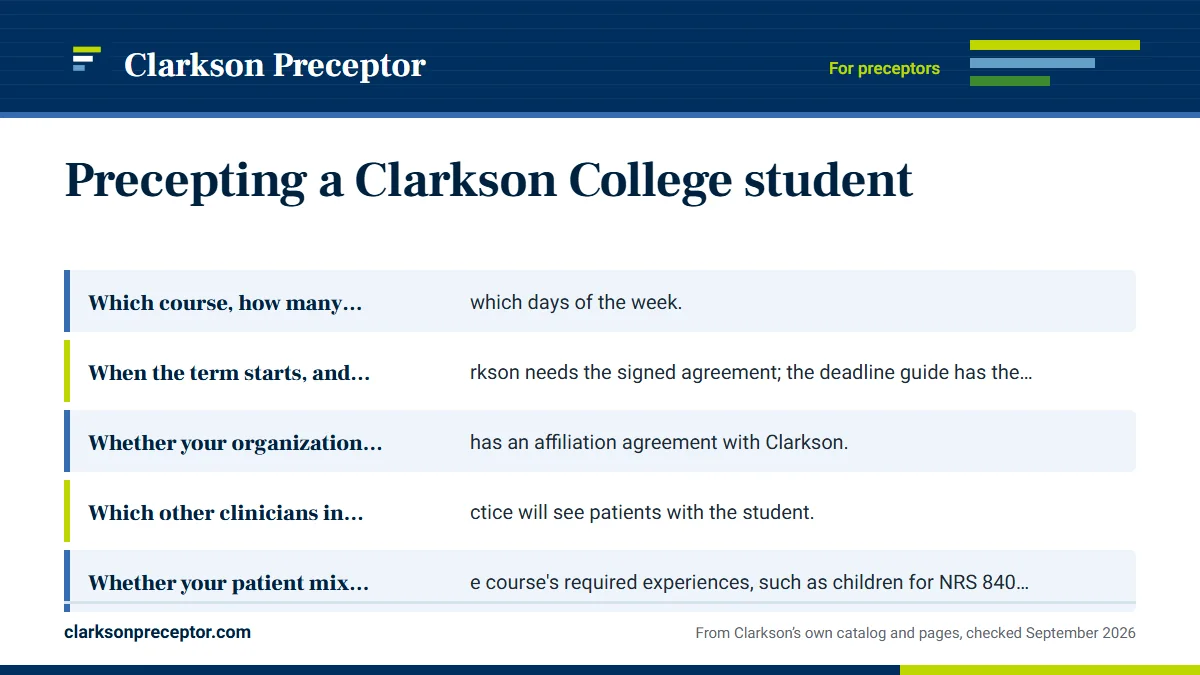
A short conversation before the agreement saves both of you a surprise in week six. Cover these with the student:
- Which course, how many hours, and which days of the week.
- When the term starts, and when Clarkson needs the signed agreement; the deadline guide has the dates.
- Whether your organization already has an affiliation agreement with Clarkson.
- Which other clinicians in your practice will see patients with the student.
- Whether your patient mix covers the course's required experiences, such as children for
NRS 840or women's health forNRS 842. - Who to call if the placement needs to change mid-course: the student's course faculty.
- For
NRS 830, whether the student has passed the Graduate Weekend check-off yet.
When a student comes to you through our placement desk, most of these are answered before the first call.
Hosting through our placement desk
Preceptors who work with our placement desk meet Clarkson students already matched to their practice: the right track and course, a schedule that fits the clinic, and the agreement details gathered in advance so your part of the DocuSign form is quick.
If you are open to hosting, tell us your specialty, state and the terms that suit you in the form on this page. Your placement advisor follows up with Clarkson students whose course fits your practice, and you decide which students to take and when. When a placement ends, we can match you with the next student whose course fits, so you teach as often as you choose and no more.
Questions Clarkson students ask
Is precepting a Clarkson College student paid?
No. Precepting a Clarkson student is an unpaid teaching role. Clarkson's side of the arrangement is the affiliation agreement with your organization, the student's compliance records and the course structure, while you give clinical teaching time across one course of 100 to 250 hours.
Do I need a Nebraska license to precept a Clarkson student?
Only if the student trains in Nebraska. Clarkson requires the preceptor to be licensed in the state where the clinical takes place, which is usually the state the student lives in. A family nurse practitioner in Texas precepting a Clarkson student in Texas needs a Texas license, not a Nebraska one.
How many hours a week does a Clarkson student need?
It depends on the course and the term. MSN courses run 100 to 180 hours and BSN to DNP courses up to 250. Across a 15-week semester, a 160-hour course needs about 11 hours a week; the 12-week summer term pushes that to about 13, with half the hours done by midterm.
Can two clinicians in my practice share a Clarkson student?
Yes. Clarkson's November 2023 sheets allow up to two preceptors per course without extra approval, and more with written approval from course faculty. Each clinician the student sees patients with needs a signed agreement, partners in the practice included, so name everyone involved before the form goes in.
What happens if I can no longer host the student?
Tell the student as early as you can. Clarkson's handbook treats a preceptor who declines to continue as an unavoidable change: the student informs course faculty and finds an alternate, and hours with the new preceptor begin only after new paperwork is complete. Early notice gives the student time to do that.
Related pages
Last checked 2026-09-27
We check these pages against Clarkson College's own catalog, program pages and published nursing documents. Your course faculty and Graduate Nursing advisor have the final word.
Clarkson asks you to find your preceptor. We make the search the easy part.
Tell us your Clarkson track, your city and your next clinical course. We line up preceptors who fit the NRS course and Clarkson's rules, gather the details the site and preceptor agreement asks for, and flag early whether the site needs a new affiliation agreement.
- Preceptors matched to the course: all-ages primary care for FNP, acute care units for AGACNP, psychiatric providers for PMHNP
- License, experience and site details checked against Clarkson's rules before the agreement is filed
- Every clinical course planned in sequence, close to home in a state where Clarkson's graduate nursing meets requirements
Start your placement plan
Track, city and next clinical course is all we need to begin.