Clarkson College AGACNP clinical sites, course by course
Clarkson College's AGACNP clinicals climb in acuity one course at a time: hospitalist short-stay and sub-acute units in NRS 861, medical-surgical floors in NRS 862, then step-down, urgent care, intensive care and emergency settings in NRS 863 and NRS 864. Any NP who precepts those hours has to hold acute care certification. The rules below come from Clarkson's November 2023 AGACNP clinical sheet and the 2026-27 catalog; your Graduate Nursing advisor holds the current version.
Get your placement plan
Tell us your Clarkson program and where you live. A placement advisor replies with the preceptor and site options that fit your course.
Which unit fits which acute care course
Clarkson describes each acute care setting twice: in the 2026-27 catalog's course description and in the settings column of its November 2023 AGACNP sheet, which still prints the older NS prefix. Together they form a ladder from brief, lower-acuity admissions up to critical care.
| Course | Catalog setting | Nov. 2023 sheet setting | Hours (MSN / BSN to DNP) | Specialty-hour cap |
|---|---|---|---|---|
NRS 830 Advanced Physical Assessment | Primary care across the lifespan | Family practice or internal medicine | 100 / 125 | None |
NRS 861 Introduction to Acute Care Concepts | Adolescent, adult and geriatric patients on short stays in sub-acute or acute care units | Hospitalist sub-acute or acute care short-stay units | 150 / 200 | 40 |
NRS 862 Applying Acute Care Concepts | Acute inpatient units such as medical-surgical | Hospitalist med/surg | 160 / 200 | 50 |
NRS 863 Complex Acute Care Concepts | Step-down units or urgent care | Hospitalist step-down, urgent care, ICU or ER | 160 / 200 | 40 |
NRS 864 Advanced Acute Care Concepts | ICUs, emergency and trauma departments | Hospitalist step-down, urgent care, ICU or ER | 180 / 250 | 56 |
One wrinkle deserves a question to faculty. The sheet treats step-down, urgent care, ICU and ER as one group covering both NRS 863 and NRS 864, while the catalog leans step-down and urgent care toward NRS 863 and reserves intensive care, emergency and trauma work for NRS 864. If a site you are weighing fits the sheet but not the catalog wording for your course, raise it with course faculty before the agreement goes in.
Every acute course requires the course below it, and Clarkson's program notes permit a single clinical course per term, so you climb rung by rung. The AGACNP program page shows how the five courses fit the degree.
Who may sign as an acute care preceptor
For NRS 861 through NRS 864, the sheet accepts four credentials: MD, DO, NP and PA. It then narrows the NP option in capital letters: "All NP preceptors MUST be Acute Care certified; cannot use FNPs." A family nurse practitioner who covers hospital shifts or staffs an urgent care schedule still falls outside that rule for your acute care hours.
NRS 830 is the exception inside the track. It is taught in family practice or internal medicine, and all four credentials qualify there, family NPs among them. The clinician who signed off your physical assessment hours may therefore not be the right person once the acute sequence begins.
Rules that apply to every Clarkson NP preceptor (November 2023 sheets)
- An active license issued by the state you train in.
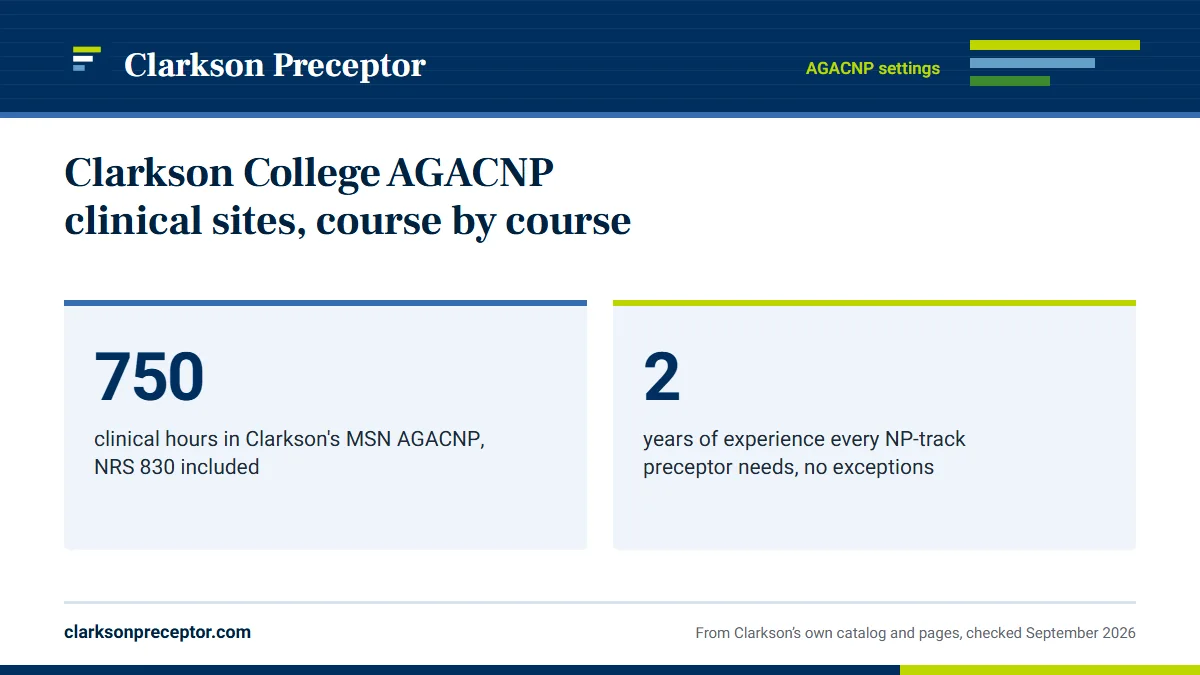
- Two or more years in practice; the sheet allows no exceptions.
- Practice that relates to the course content.
- No family members, extended family included.
- A ceiling of two preceptors per course, lifted only by written faculty approval.
- PAs barred from precepting in four states: Arizona, Florida, Maryland and Oklahoma.
The full list, alongside the other tracks' limits, sits on the preceptor requirements page.
Site types, specialty hours and observation
The AGACNP sheet names five kinds of site: specialty clinics, outpatient primary care clinics, rural health clinics, urgent care clinics and hospitals. The clinic types suit NRS 830 and its family practice or internal medicine focus. The acute courses point mostly to hospital services, with urgent care entering the picture late in the sequence.
Specialty hours are time spent with a specialty provider rather than in the course's main setting. The sheet allows none in NRS 830, then caps them at 40 in NRS 861, 50 in NRS 862, 40 in NRS 863 and 56 in NRS 864. Course faculty approve that time, so a day with a cardiology or pulmonary service belongs in the plan before it happens, and its provider needs a completed agreement like anyone else.
Observation is a separate category. Once NRS 830 is done, each course may include as many as 10 optional observation hours. They need course faculty approval in advance, involve no hands-on care, need no DocuSign agreement and still go into Typhon.
When the hospital is also your employer
Clarkson's 2021-22 graduate handbook keeps every graduate nursing student employed as an RN for the whole program, so the hospital you know best may well be the one that pays you. That can help, as long as you stay off your own unit.
The sheet permits clinical hours at your employer, but never on your home unit. If you staff a step-down unit, your NRS 863 hours belong on another service; if you work in an emergency department, NRS 864 needs a different one or an ICU. Keep paid shifts and clinical hours in separate records so neither is mistaken for the other. The workplace clinicals page covers the rest.
Nebraska Medicine employees have one more step. The sheet told staff there to contact the Director before starting preceptor hours to obtain a separate Epic log-on, and Clarkson's 2025 resources page routed Epic questions to the Director of Graduate Nursing's office. Settle it before your first student shift.
Omaha health systems and the AGACNP track
Clarkson's former resources page pointed students in Nebraska, Iowa and South Dakota to a handful of health-system request routes. For acute care students they are far from equal, and each system decides on its own requests.
Nebraska Medicine, which Clarkson calls its educational partner, accepts student requests only through its online application, wants students to stay away from contacting its preceptors, and says the process runs a month or more. Each nurse practitioner window lasts one month: September for spring placements, January for summer and April for fall, each opening on the first.
Children's Nebraska is the one to cross off. The student groups on its advanced practice page are nurse anesthesia students plus neonatal, pediatric (primary and acute care) and psychiatric NP students, so an AGACNP request has no track to land in, even though NRS 861 includes adolescents.
CHI Health publishes only an undergraduate toolkit, and Clarkson's 2025 page said CHI gives its own employees priority. Methodist has taken down its APP preceptorship application. The health system requests page keeps each route current.
How our desk builds an AGACNP site plan
Clarkson students choose us for the acute care track because we plan the ladder as one project instead of four separate scrambles. Your placement advisor maps NRS 861 through NRS 864 to units near you, inside a state Clarkson's workbook clears for graduate nursing, and looks for hospitalist groups, step-down teams and critical care services that can carry you up the sequence.
Every NP we put forward is checked for acute care certification first, then for licensure where you will train, two years in practice and any family connection. We name each provider you will actually see patients with, so every one of them gets an agreement, and we keep specialty time inside each course's cap.
We collect the credentials, legal names and contacts that go into DocuSign, tell you early when a hospital has never contracted with Clarkson's Compliance office, and aim every file at the term's filing date with room to spare. Send your next course code with the contact form; the steps are on how it works.
Questions Clarkson students ask
Can a family nurse practitioner precept my Clarkson AGACNP clinical?
Not in the acute care courses. Clarkson's November 2023 AGACNP sheet says every NP preceptor in NRS 861 through NRS 864 must be acute care certified and rules out FNPs by name. An FNP can still precept NRS 830, which sits in family practice or internal medicine. MDs, DOs and PAs remain options in the acute courses, apart from PAs in the four excluded states.
Can I complete AGACNP hours in urgent care?
Yes, in the later part of the sequence. The catalog names urgent care for NRS 863, and the November 2023 sheet lists urgent care alongside step-down, ICU and ER for both NRS 863 and NRS 864. The provider still has to qualify as an MD, DO, PA or acute care NP holding a license where you train and at least two years behind them.
Does Children's Nebraska take AGACNP students?
Its advanced practice provider page supports anesthesia, neonatal, pediatric and psychiatric APRN students (CRNA, NNP, PNP, PNP-AC and PMHNP). Adult-gerontology acute care is not on that list, so a Children's request is not a route for your acute care hours. Children's runs requests for the tracks it supports through myClinicalExchange, with fixed deadlines.
How many specialty hours can I count in each acute care course?
Clarkson's November 2023 AGACNP sheet caps specialty hours at 40 in NRS 861, 50 in NRS 862, 40 in NRS 863 and 56 in NRS 864, with none in NRS 830. Specialty days need a nod from course faculty beforehand, and that provider also needs finished paperwork. Ask faculty whether the caps shift for BSN to DNP students, whose course totals are higher.
Can a PA precept Clarkson acute care NP students?
In most states, yes. The sheet lists MD, DO, NP and PA as acceptable preceptors for NRS 861 through NRS 864. The exception is geography: Clarkson's NP sheets rule PAs out as preceptors in Arizona, Florida, Maryland and Oklahoma. Anywhere else, a PA who has practiced two years and is licensed in your clinical state can qualify.
Related pages
Last checked 2026-09-27
We check these pages against Clarkson College's own catalog, program pages and published nursing documents. Your course faculty and Graduate Nursing advisor have the final word.
- Clarkson College catalog 2026-27: NRS 861 Introduction to Acute Care Concepts
- Clarkson College catalog 2026-27: NRS 864 Advanced Acute Care Concepts
- Clarkson College AGACNP Clinical Rotation Information, revised November 2023 (archived)
- Children's Nebraska: advanced practice provider students
- Nebraska Medicine: student placement
Clarkson asks you to find your preceptor. We make the search the easy part.
Tell us your Clarkson track, your city and your next clinical course. We line up preceptors who fit the NRS course and Clarkson's rules, gather the details the site and preceptor agreement asks for, and flag early whether the site needs a new affiliation agreement.
- Preceptors matched to the course: all-ages primary care for FNP, acute care units for AGACNP, psychiatric providers for PMHNP
- License, experience and site details checked against Clarkson's rules before the agreement is filed
- Every clinical course planned in sequence, close to home in a state where Clarkson's graduate nursing meets requirements
Start your placement plan
Track, city and next clinical course is all we need to begin.